
Track Car Reviews
The 8 Best Cars Under $25K You Can Actually Drive to Your Track Day
By Hot Lap Rentals · 10 min read
February 14, 2026By Hot Lap Rentals Staff Writer• 13 min readBy Hot Lap Rentals | February 2026
Here's the dirty little secret of track days: you don't need a six-figure exotic to have the time of your life between the cones. In fact, some of the fastest guys and gals at any given HPDE are piloting machines that cost less than a mid-trim Camry. The real flex isn't pulling up in something expensive — it's pulling up in something cheap, driving the wheels off it for six sessions, and then cruising home with the AC blasting and your ego fully intact.
We went hunting for the best track-capable cars you can buy for under $25,000 that won't leave you stranded on the shoulder of I-85 on the way home from Road Atlanta. The rules were simple: it needs decent power, no catastrophic reliability skeletons in the closet, and it has to function as actual transportation — not a trailer queen with a roll cage and no carpet.
We rated each car across four categories on a scale of 1 to 10:
- Horsepower — Raw grunt. More is more, until it isn't.
- Power-to-Weight — The number that actually matters when the flag drops.
- Cool Factor — Does it turn heads in the paddock, or does it just turn stomachs?
- Daily Usability — Can you commute in it Monday without hating your life choices?
Let's get into it.
1. Chevrolet C5 Corvette (1997–2004)
Price Range: $12,000–$24,000 | Engine: 5.7L LS1 V8 | Power: 345–405 hp | Weight: ~3,200 lbs
The C5 Corvette is the undisputed king of performance-per-dollar, and honestly, it's not even close. The LS1 makes 345 horsepower in base trim — or 405 in the Z06 — and the whole package weighs about as much as a modern compact crossover. That rear-mounted transaxle gives you a near-perfect 50/50 weight distribution, and the aftermarket support for LS engines is so deep it could fill Lake Lanier.
Yes, the interior is pure late-'90s GM rental car chic. Yes, your coworkers will assume you're having a midlife crisis. But once you're stacking up 1:35s at AMP while the M3 guys are in the paddock nursing overheated brakes, none of that matters.
Watch for: Harmonic balancer failure on higher-mileage cars, column lock issues, and the occasional leaky rear main seal. Budget for good brake pads and fresh fluid — the stock brakes will fade faster than your enthusiasm for the stock seats.
CategoryScoreHorsepower9/10Power-to-Weight9/10Cool Factor7/10Daily Usability6/10Overall7.8/10
2. Ford Mustang GT (S197, 2011–2014)
Price Range: $14,000–$23,000 | Engine: 5.0L Coyote V8 | Power: 412–420 hp | Weight: ~3,600 lbs
When Ford dropped the Coyote 5.0 into the S197 chassis for 2011, it was a watershed moment. Four hundred and twelve horsepower, a screaming 7,000-rpm redline, and the kind of V8 soundtrack that makes bald eagles weep with patriotic fervor. The 2011+ GT is a legitimate track weapon that also happens to have rear seats, a usable trunk, and enough road manners to commute in without filing a workers' comp claim against your own spine.
The aftermarket is, predictably, enormous. Lowering springs, bigger sway bars, and a set of good pads will transform this thing from a competent muscle car into something that'll genuinely worry Cayman drivers in the intermediate run group. The live rear axle on pre-2015 cars isn't ideal, but generations of Mustang racers have proven it's plenty capable with the right setup.
Watch for: The MT-82 six-speed manual can be notchy and fragile under hard use — consider budgeting for a transmission upgrade if you're going to be aggressive. Oil consumption on some early Coyotes is worth monitoring.
CategoryScoreHorsepower9/10Power-to-Weight7/10Cool Factor7/10Daily Usability8/10Overall7.8/10
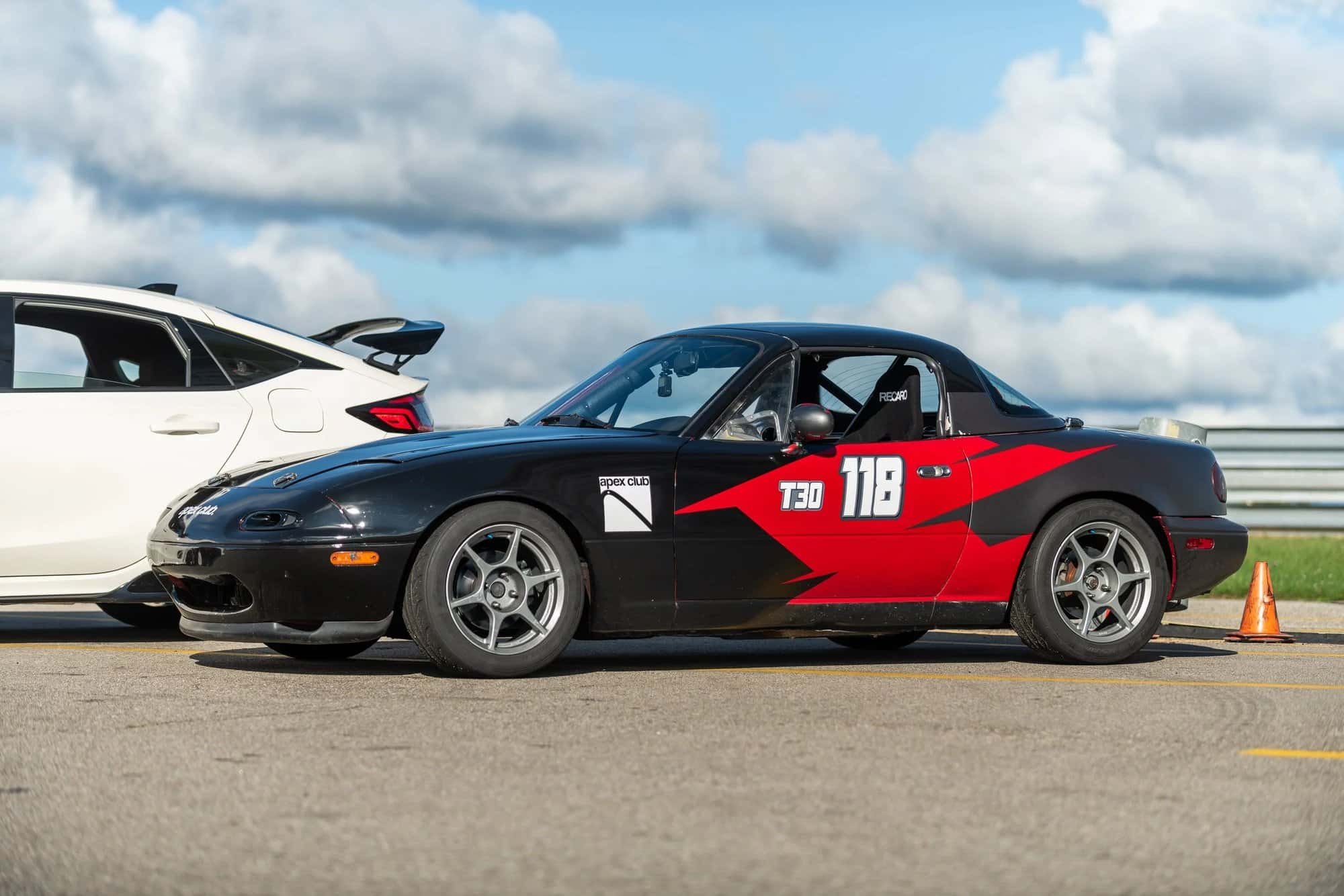
3. Mazda MX-5 Miata (NC, 2006–2015)
Price Range: $8,000–$18,000 | Engine: 2.0L I4 | Power: 158–167 hp | Weight: ~2,500 lbs
"Miata Is Always The Answer" stopped being a meme years ago — it's just a fact of automotive physics at this point. The NC generation is the sweet spot for track use: it's more rigid than the beloved NA and NB, more powerful, and you can still find clean examples all day long for well under our budget. The 2.0-liter four-cylinder makes a modest 167 horsepower, which sounds embarrassing on paper but feels absolutely heroic when you're carrying 95% of your corner speed through Turn 7.
The Miata teaches you more about driving than any 500-horsepower muscle car ever will. It rewards smoothness, punishes laziness, and gives you the kind of feedback through the steering wheel that modern electric-assist systems have all but killed. It's also dead reliable, cheap to maintain, and gets 30 mpg on the highway drive home. Your back, however, may file a formal complaint.
Watch for: Rust on earlier models (especially in northern climates), soft top wear, and the fact that you'll have approximately zero cargo space for your track gear. A good roll bar is a critical investment.
CategoryScoreHorsepower4/10Power-to-Weight6/10Cool Factor7/10Daily Usability7/10Overall6.0/10
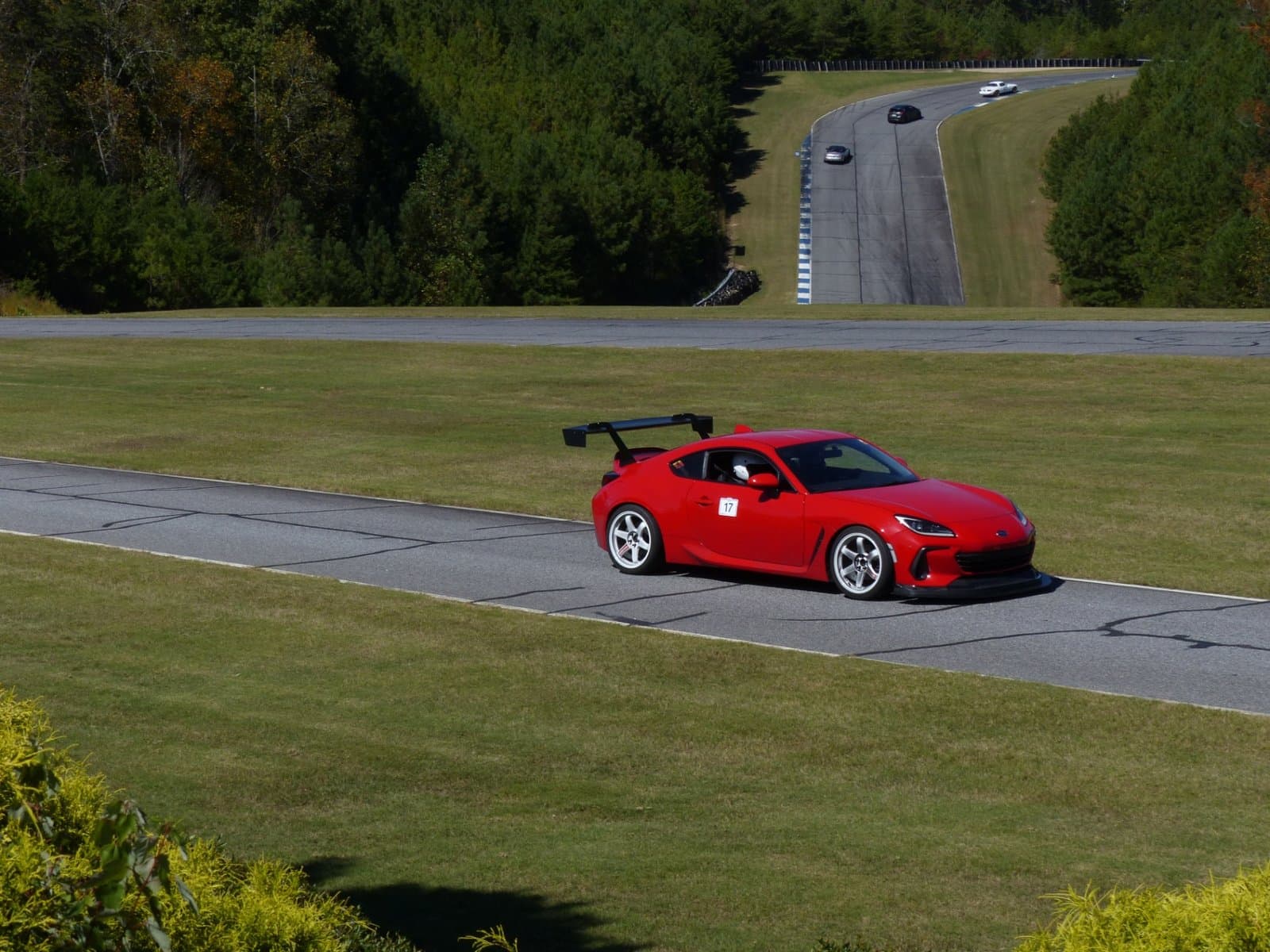
4. Subaru BRZ / Scion FR-S / Toyota 86 (2013–2020)
Price Range: $12,000–$22,000 | Engine: 2.0L Boxer H4 | Power: 200 hp | Weight: ~2,760 lbs
Think of the Toyobaru twins as a Miata that went to the gym, grew a roof, and got serious about its track career. The 2.0-liter boxer four makes 200 horsepower, the center of gravity is lower than a limbo champion's back, and the chassis balance is the kind of thing engineers write love letters about. Rear-wheel drive, available six-speed manual, and a limited-slip differential that actually works — this thing was purpose-built for the kind of driving you do between apexes.
The first-gen cars are now old enough that prices have come way down, putting clean, low-mileage examples solidly in the $15,000 range. The aftermarket has had over a decade to mature, so everything from coilovers to turbo kits are well-documented and readily available. It's also a perfectly civilized daily driver with actual back seats (for very small humans or very large bags of track snacks).
Watch for: The infamous torque dip around 3,500–4,500 rpm on pre-2017 cars can be addressed with a tune or header swap. Valve spring recalls affected some early models. Throw-out bearing noise is common but not always catastrophic.
CategoryScoreHorsepower5/10Power-to-Weight7/10Cool Factor8/10Daily Usability8/10Overall7.0/10
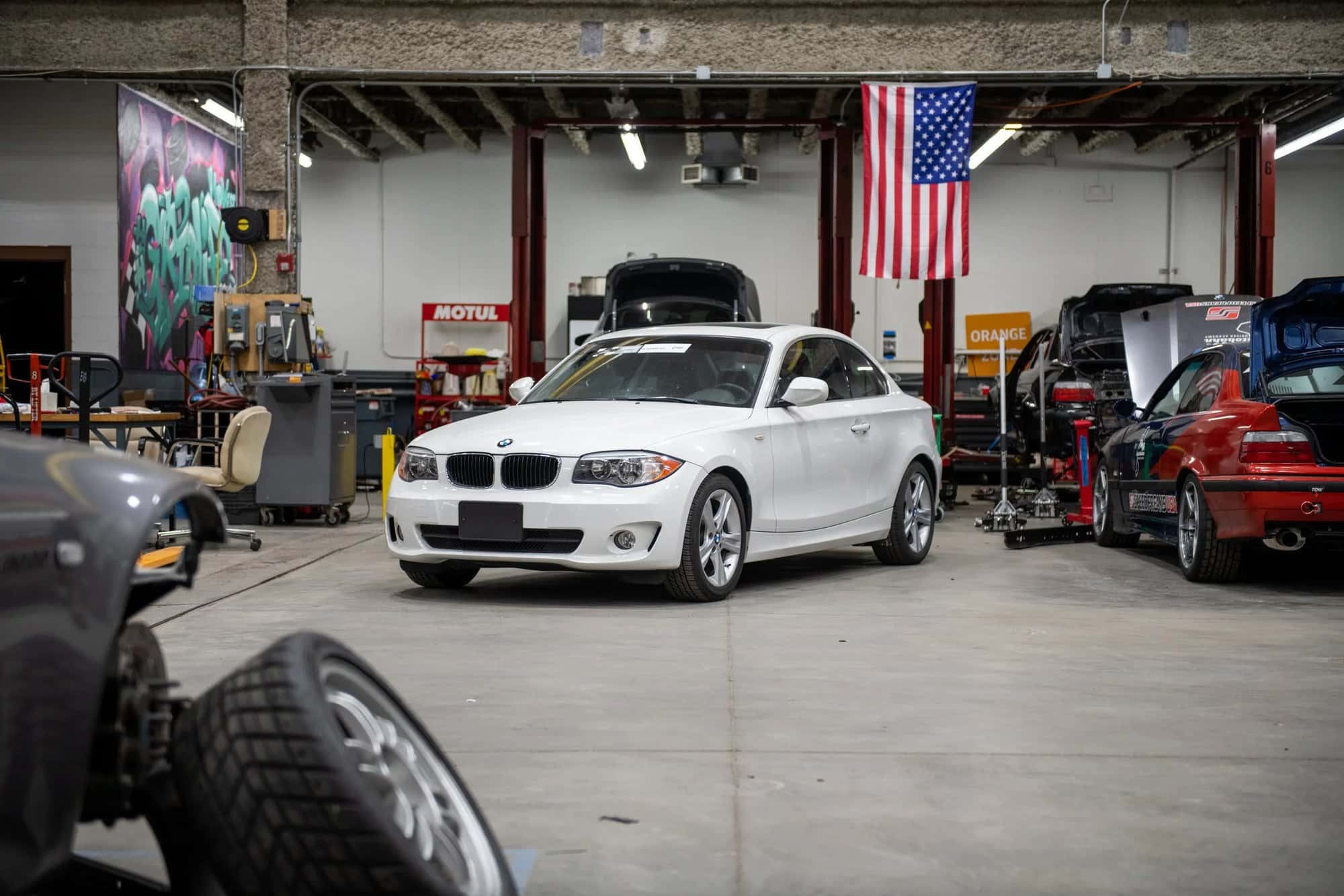
5. BMW 128i / 135i (E82, 2008–2013)
Price Range: $10,000–$22,000 | Engine: 3.0L I6 (NA or Twin-Turbo) | Power: 230–300 hp | Weight: ~3,300 lbs
The E82 1 Series is the BMW that enthusiasts have been crying about losing ever since Munich decided every car needs to weigh 4,500 pounds and look like it's angry at you. The 128i with its naturally aspirated 3.0-liter inline-six is an absolute gem — smooth, rev-happy, and reliable enough to run hard all day. The 135i cranks things up to 300 turbocharged horsepower and turns the little coupe into a legitimate straight-line threat, though you're also signing up for twin-turbo maintenance.
The E82's compact footprint, near-perfect weight distribution, and communicative hydraulic steering make it a riot on technical tracks. It's also a BMW, which means it has an actual interior, comfortable seats, and enough refinement to make the 200-mile highway slog to your nearest circuit perfectly pleasant.
Watch for: The N54 twin-turbo in the 135i has a laundry list of potential issues — high-pressure fuel pump, wastegate rattle, oil leaks, and water pump failures are all common. The N52 in the 128i is significantly more reliable and arguably more fun for learning. Budget for cooling system maintenance on either.
CategoryScoreHorsepower7/10 (128i) — 8/10 (135i)Power-to-Weight7/10Cool Factor8/10Daily Usability8/10Overall7.5/10
6. Nissan 350Z (2003–2009)
Price Range: $10,000–$20,000 | Engine: 3.5L VQ35 V6 | Power: 287–306 hp | Weight: ~3,300 lbs
The 350Z is the car that proved Nissan still had a pulse in the sports car game, and nearly two decades later, it remains one of the best-balanced front-engine, rear-drive platforms you can buy on a budget. The VQ35 V6 is a naturally aspirated masterpiece — 287 to 306 horsepower depending on year, with a glorious top-end wail that sounds like it's auditioning for a Fast & Furious sequel. Paired with a six-speed manual and a Viscous LSD, this thing is ready for the track right out of the box.
The Z's relatively short wheelbase makes it playful in transitions, and the Brembo brakes on later models are genuinely impressive for a car at this price point. It's also surprisingly comfortable as a daily, with enough trunk space for a helmet bag and a change of clothes — which is really all you need.
Watch for: Oil consumption on the DE-series engines (pre-2007) is a known thing. The HR engine (2007+) is the one to get if you can swing it. Clutch concentric slave cylinders can be a pain to replace. The interior ages about as gracefully as a sandcastle.
CategoryScoreHorsepower8/10Power-to-Weight7/10Cool Factor7/10Daily Usability7/10Overall7.3/10
7. Hyundai Genesis Coupe 3.8 (2013–2016)
Price Range: $12,000–$20,000 | Engine: 3.8L V6 | Power: 348 hp | Weight: ~3,450 lbs
The Genesis Coupe is the sleeper pick of this list, and we mean that in the most complimentary way possible. The 3.8-liter V6 in the later models pumps out a genuine 348 horsepower — naturally aspirated — and sends it to the rear wheels through either a six-speed manual or an eight-speed automatic. Brembo brakes come standard on R-Spec models. Three hundred and forty-eight horsepower. Brembos. Rear-wheel drive. Under twenty grand. We'll wait while you do the math.
The Genesis Coupe doesn't get the respect it deserves in the enthusiast community, partly because of badge snobbery and partly because the 2.0T models gave the platform a reputation for being unreliable (the turbo four was, in fact, kind of fragile). The 3.8 V6 is a different animal entirely — robust, torquey, and perfectly happy being driven hard. The chassis is more grand tourer than scalpel, but with some suspension work, it's genuinely competitive.
Watch for: Skip the 2.0T entirely for track use — the 3.8 V6 is the move. Some owners report differential whine on higher-mileage cars. The aftermarket is smaller than the Japanese competition, but growing.
CategoryScoreHorsepower8/10Power-to-Weight7/10Cool Factor6/10Daily Usability8/10Overall7.3/10
8. Volkswagen GTI (Mk6/Mk7, 2010–2020)
Price Range: $10,000–$23,000 | Engine: 2.0L Turbo I4 | Power: 200–220 hp | Weight: ~3,100 lbs
The GTI is the Swiss Army knife of this list. It's the car you buy when you want to run clean fast laps at Barber, pick up groceries on the way home, and then parallel park it in a downtown spot without breaking a sweat. The 2.0-liter turbo four makes between 200 and 220 horsepower depending on generation, which doesn't sound like much until you realize the thing weighs just over 3,100 pounds and has one of the best front-wheel-drive chassis ever engineered.
Yes, it's FWD. Get over it. The GTI's electronically controlled limited-slip differential (on Mk7 Performance Pack cars) manages torque steer with surgical precision, and the platform's balance in high-speed corners will make you forget which wheels are doing the pulling. It's also absurdly practical — four doors, a hatchback, comfortable seats, and the kind of interior quality that makes you wonder how Volkswagen makes any money at this price point.
Watch for: The Mk6's timing chain tensioner is a known failure point — listen for rattle on cold starts and address it immediately. Mk7s are generally bulletproof, but water pump and thermostat failures crop up around 80,000 miles. DSG transmissions need their fluid changed on schedule or they get cranky.
CategoryScoreHorsepower6/10Power-to-Weight6/10Cool Factor7/10Daily Usability10/10Overall7.3/10
The Final Grid
RankCarHPP/WCoolDailyOverall1C5 Corvette99767.82S197 Mustang GT97787.83BMW E82 1 Series77887.54Nissan 350Z87777.35Genesis Coupe 3.887687.36VW GTI (Mk6/Mk7)667107.37BRZ / FR-S / 8657887.08Mazda MX-5 (NC)46776.0
The Bottom Line
Every car on this list will put a massive grin on your face at a fraction of what most people spend on their daily drivers. The C5 Corvette and Coyote Mustang GT are the raw performance bargains. The BRZ/86 twins and the Miata are the driver's-school valedictorians. The BMW and the 350Z split the difference between refinement and rowdiness. The Genesis Coupe is the value play nobody's talking about. And the GTI is proof that you can have your track day cake and eat it in a car that doesn't punish you for the other 360 days of the year.
The best part? At these prices, you'll have plenty left in the budget for the stuff that actually makes you faster — good tires, proper brake pads, a solid helmet, and maybe a track day with one of our partners to learn the ropes.
We'll see you at the grid.
Hot Lap Rentals connects track day enthusiasts with the cars, events, and education they need to get on track. Visit HotLapRentals.com to find your next track day experience.
Track DaysHPDEBest Track Cars Under 25K in 2026
In the directory
1994 Mazda Miata Track Car NA
Quote only /day
1997 BMW M3 Track Car E36
Quote only /day
2001 Mazda Miata Track Car NB2
Quote only /day
2012 BMW 128i Track Car E82
Quote only /day